 SaaS Explained
What a SOC 2 report describes
Last reviewed
The short version
- A SOC 2 report comes from an audit of a company's controls.
- Those controls protect the systems and data the company runs for customers.
- It covers up to five areas, called the Trust Services Criteria.
- It describes what an auditor found. It doesn't promise that nothing will ever go wrong.
What SOC stands for
SOC stands for System and Organization Controls. It's a suite of reports produced during an audit.[1] An audit is a careful check by an outside expert.
The AICPA, a body for US accountants, sets the standards. Its certified public accountants (CPAs) can offer these reports. They give users what they need to judge the risks of outsourcing a service.[2] Outsourcing here means paying another company to run something for you, like a SaaS provider.
The five areas
SOC 2 reports focus on controls grouped into five categories, the Trust Services Criteria.[1] A control is a rule or safeguard the company uses.
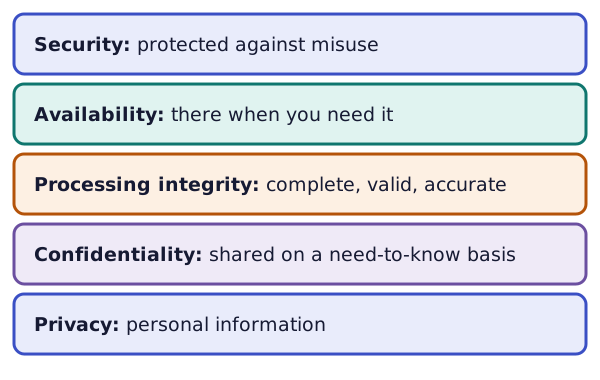
The five are security, availability, processing integrity, confidentiality and privacy.[1] In short, they ask whether information and systems are protected and available for use. They also ask whether processing is complete, valid and accurate, and whether information is shared on a need-to-know basis.[1]
An engagement can address some of the categories and not others.[1] So when you read a report, check which areas are in it.
Type 1 and Type 2
These are two levels of report.
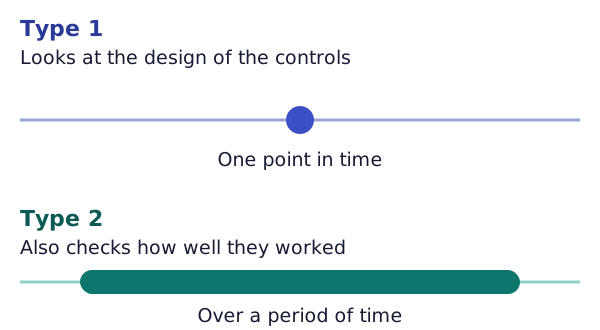
- Type 1 describes the company's systems and whether the design of the controls meets the criteria.[1] Think of it as a photo of the plan.
- Type 2 also looks at how well the controls worked over a period of time.[1] Think of it as a film, not a photo.
SOC 1, SOC 2 and SOC 3
There are three main kinds of SOC report. SOC 1 is about controls over financial reporting. SOC 2 is about the Trust Services Criteria. SOC 3 is a general-use version of SOC 2.[1]
SOC 1 and SOC 2 reports are meant for a limited audience.[1] SOC 3 reports hold less detail and can go to the general public.[1]
Reading one sensibly
A SOC 2 report is one piece of evidence. It tells you what an auditor looked at and found, and over what dates. It doesn't prove a service is right for you.
Things to look for:
- Which of the five areas does it cover?
- Is it Type 1 or Type 2?
- What period does it cover?
For help judging a report, ask a qualified professional, such as an accountant or a security adviser.
Sources
- System and organization controls, Wikipedia (accessed 2026-11-18)
- System and Organization Controls: SOC Suite of Services, AICPA & CIMA (accessed 2026-11-18)